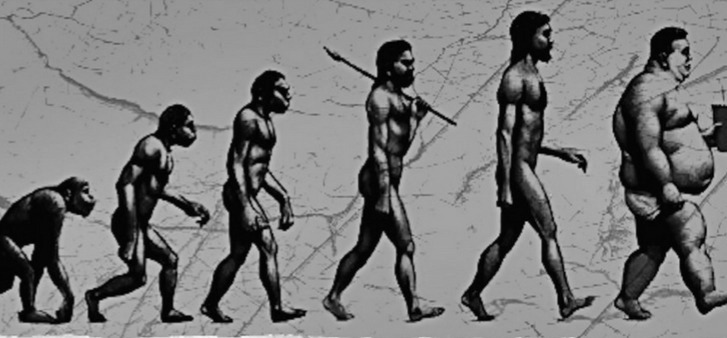
Evolutionaire geneeskunde versus reguliere geneeskunde

Sjoerd Knobben

Sjoerd Knobben

Psycholoog en klinisch-psychoneuroimmunologisch (kPNI) therapeut (leefstijlgeneeskunde).

Inhoudsopgave

Evolutionaire geneeskunde versus reguliere geneeskunde

Het idee dat een goed begrip van evolutie belangrijk is bij de preventie en behandeling van (menselijke) ziekten wordt al langere tijd erkend (1). In het begin van de jaren zestig werd gesteld dat niets in de biologie pas echt logisch is, behalve wanneer het bekeken wordt in het licht van evolutie. Helaas is evolutie niet de zienswijze (paradigma) dat gebruikt wordt in de reguliere geneeskunde. Men hanteert vooral een proximale (dichtbije) kijk op redenen en oorzaken van ziekten. Dit leidt tot het redeneren vanuit symptomen of klachten en waarbij ‘diepere’ biologische mechanismen niet worden meegenomen in het gezondheidsproces. De patient wordt niet in zijn geheel (hollisme) of als een biologische samenwerkend systeem gezien. Hierdoor komt het in de reguliere geneeskunde voornamelijk neer op het reduceren van pijn of klachten.

In de evolutionaire geneeskunde en het nauw verwante klinische psychoneuroImmunologische (kPNI) therapie wordt er gekeken naar de ultieme ofwel (verdere) oplossing en evolutionaire reden voor het ontstaan van ziekte (ziektefilm). Hierdoor is de behandeling gericht is op het herstellen van onderliggende mechanismen die ten grondslag liggen aan gezondheid (1). 

Vele, zo niet alle ziekten kunnen worden verklaard door een proximale en ultieme uitleg en ook behandeld worden. Wanneer we echter willen gaan voor preventie van (chronische) ziekte en optimale gezondheid (en daarmee ook weerbaarheid voor infectieziekten), zullen we meer moeten doen dan alleen het reduceren van klachten (1).

Waarom de gezondheidszorg zou moeten evolueren

In de tijd dat infectieziekten onze grootste uitdaging was, voldeed de proximale kijk op ziekte wellicht meer. Echter, neemt met name de laatste decennia zogenoemde welvaartsziekten, zoals kanker, hart- en vaatziekten, auto-immuunziekten, psychische aandoeningen, diabetes in ernstige mate toe. Met als gevolg een afname van kwantiteit en kwaliteit van leven en enorme zorgkosten. Volgens de wereld gezondheid organisatie heeft 57% van de mens in 2020 zo’n chronische welvaartsziekte (21). We krijgen deze ziekten bovendien op steeds jongere leeftijd. Dit staat in schril contrast met mensen die nog leven als jager-verzamelaar. Zij krijgen deze ziekten niet en worden ook ouder dan 70 jaar.

Dit soort cijfers en bijvoorbeeld de toename aan overgewicht bij mensen, ondersteund dat huidig beleid faalt en de proximale zienswijze niet meer de aangewezen methode van denken en handelen kan zijn. Het lost niet het probleem van chronische welvaartsziekten op en het wordt financieel onbetaalbaar, om de pappen nat te houden. De meest logische oplossing is evolutionaire (leefstijl) geneeskunde. Helaas zijn hier enkele barrieres aanwezig. Het is complexer, lijkt paradoxaal en staat soms zelfs haaks op hedendaags beleid. Bovendien, wanneer een platte wereld het verdienmodel is, dan houdt je de wereld plat. Naast dat veel artsen (onbewust) vasthouden aan het oude doen o.a. de farmaceutische industrie en politieke bondgenoten dit idem dito. Er valt namelijk maar weinig te verdienen aan voeding, leefstijl en gezonde mensen.


"It is difficult to get a man to understand something when his salary depends upon his not understanding it."

Arts dr. R.M. Nesse over evolutionaire geneeskunde

Hieronder kunt u lezen hoe arts dr. R.M Nesse verder antwoord geeft op een aantal relevante vragen betreft evolutionaire geneeskunde c.q. psychoneuroimmunologie.

Medical doctor R. M. Nesse van ‘The center for evolution and medicine, Arizona state university’:


1. What is evolutionary medicine?

How I look forward to the day when no one needs to ask! Evolutionary medicine, sometimes called Darwinian medicine, is the field at the intersection of evolution and medicine. Evolution AND Medicine is a better descriptor, but that has not caught on. The field uses the basic science of evolutionary biology to find ways to prevent and treat disease, and it uses studies of disease to advance basic evolutionary biology (2).


2. What isn’t evolutionary medicine?

Evolutionary medicine is not radical or alternative. It is not a special kind of medical practice. It does not advocate any particular kind of diet, exercise, or treatment. It does not make direct clinical recommendations based on theory alone (3). If your doctor claims to practice evolutionary medicine, be sure that treatment recommendations are based on controlled scientific studies; if they come directly from theory, find a better doctor. Evolutionary medicine is standard mainstream medical science, appropriately cautious about making clinical recommendations.


3. How does evolutionary medicine transform our understanding of disease?

Evolutionary medicine poses a fundamentally new kind of question about disease. Instead of only asking how bodies work and why some people get sick, evolutionary medicine also asks why natural selection has left all of us with traits that make us vulnerable to disease (20). Why do we have wisdom teeth, narrow coronary arteries, a narrow birth canal, and a food passage that crosses the windpipe? Evolution explains why we have traits that leave us vulnerable to disease, as well as why so many other aspects of the body work so well. For instance, the usual question about back pain is why it afflicts some individuals. Evolutionary medicine also asks why back problems have been a problem for all hominid species since they first walked on two legs.


4. Is evolutionary mainly about diseases caused by our modern environments?

Most chronic disease results because our bodies are poorly prepared to stay healthy in modern environments (4), but this is only one of several evolutionary explanations for why we get sick (5). Vulnerability to infections persists because pathogens evolve so quickly. Not all deleterious mutations can be eliminated because there are limits to what natural selection can do. Other vulnerabilities result from inevitable tradeoffs, including the big one of maximizing reproduction even when that harms health. Also, selection has shaped many defenses, such as inflammation, whose utility comes at a substantial cost in tissue damage and suffering. These are not alternatives to standard medical explanations, they are complementary deeper explanations.


5. Is evolutionary medicine only about vulnerabilities?

No, questions about vulnerability are only one part of evolutionary medicine. Some scientists use DNA evidence to trace the evolutionary history of humans and pathogens. Some use evolution to discover new ways to prevent resistance to antibiotics and cancer chemotherapy drugs. Others study why selection cannot remove some genetic variations that cause disease. Evolutionary medicine includes all aspects of evolutionary biology applied to all problems in medicine and public health.


6. Evolutionary medicine shows how diseases are useful, right?

Wrong. Diseases are not adaptations shaped by selection. There is nothing useful about pneumonia, schizophrenia, epilepsy, or cancer. Trying to understand diseases as if they are adaptations is a mistake, one that is unfortunately as common as it is serious (6). However, many symptoms of disease, such as pain, fever, vomiting, cough, and fatigue, are adaptations. The systems that regulate such defenses are, for good evolutionary reasons, prone to failures that cause chronic pain, anxiety disorders, and many other diseases.


7. Is evolutionary medicine useful?

It sure is! Some applications are relatively direct— doctors who understand how selection shaped regulation mechanisms can make better decisions about when it is safe to use drugs to block fever and cough (2,3). However, like genetics and microbiology, evolution is a basic science that mainly provides new understanding that lead to new treatments (7,8,20). Evolutionary models that analyze the evolutionary competition between cells in a malignancy have led to new chemotherapy strategies that greatly extend the lives of mice with cancer (9). Models of antibiotic resistance suggest that “take every pill in the bottle” may be bad advice (10). We must find out what in our modern environment is causing the new epidemic of autoimmune diseases like diabetes, multiple sclerosis, and Crohn’s disease (11).


8. Don’t most doctors already know all about evolution?

No, most doctors would likely fail the midterm in an introductory evolution class (13,14). Even medical leaders often have gross misconceptions. A famous geneticist once suggested at a big Darwin meeting that selection keeps mutations happening for the good of the species, an idea has been recognized as a mistake for 50 years. The belief that long association with a host makes viruses milder remains common among physicians, decades after Paul Ewald and others pointed out that selection maximizes transmission of pathogens even if that kills the host. Engineers learn the principles of thermodynamics so they don’t make mistakes like trying to build perpetual motion machines. Doctors never learn the principles of evolutionary biology, so major misconceptions persist in medicine (15).


9. Why don’t medical schools teach evolution the same way they teach other sciences?

Most medical schools have no evolutionary biologists on faculty, few doctors who know much about evolution, and some who think bodies are products of intelligent design. Even the core idea that evolutionary explanations are needed to complement descriptions of mechanisms is unfamiliar to most doctors. Some display their naiveté of methods for testing evolutionary hypotheses by spouting the phrase “just so stories,” as if that is a devastating critique. Some actually teach “just so stories.” That evolution in the medical curriculum remains in the 19th century is shameful.


(Figure from 14­ Hidaka et al. 2015 BMC Medical Education)


10. How long will it take for medicine and public health to make full use of evolutionary biology?

Progress is now rapid (16). The International Society for Evolution, Medicine and Public Health has created a network of evolutionarily sophisticated researchers, educators, and clinicians, and new education resources, including EvMedEd.org. Several new textbooks are available (8,17,18) along with a new journal, Evolution, Medicine, & Public Health, and The Evolution and Medicine Review. The evolution questions recently added to medical school entrance examinations are spurring enrollment in evolution courses. Students who have taken an undergraduate evolutionary medicine course are arriving at medical school full of new questions. They will grow up to be medical school deans. When they do, evolutionary biology will finally be recognized widely as an essential basic science for medicine.

Wetenchappelijke referenties

(1). Kuipers, R., Joordens, J., & Muskiet, F. (2012). A multidisciplinary reconstruction of Palaeolithic nutrition that holds promise for the prevention and treatment of diseases of civilisation. Nutrition Research Reviews,25(1), 96-129. doi:10.1017/S0954422412000017


(2). Nesse RM, Williams GC. Why we get sick : the new science of Darwinian medicine. 1st Vintage Books. New York: Vintage Books; 1996. xi, 290 p.


(3). Nesse RM. Ten questions for evolutionary studies of disease vulnerability. Evol Appl [Internet]. 2011;4(2):264–77. Available from: http://dx.doi.org/10.1111/j.1752­4571.2010.00181.x


(4). Gluckman PD, Hanson M. Mismatch: why our world no longer fits our bodies. New York: Oxford University Press, USA; 2006.


(5). Nesse RM. Maladaptation and natural selection. Q Rev Biol [Internet]. 2005 Mar;80(1):62–70. Available from: http://www.ncbi.nlm.nih.gov/pubmed/15884737


(6). Nesse RM. Ten questions for evolutionary studies of disease vulnerability. Evol Appl [Internet]. 2011;4(2):264–77. Available from: http://dx.doi.org/10.1111/j.1752­4571.2010.00181.x


(7). Stearns SC. Evolutionary medicine: its scope, interest and potential. Proc Biol Sci [Internet]. 2012 Nov 7;279(1746):4305–21. Available from: http://www.ncbi.nlm.nih.gov/pubmed/22933370


(8). Stearns SC, Medzhitov R. Evolutionary medicine. Sunderland, MA: Sinauer Associates, Inc., Publishers; 2016.


(9). Gatenby RA, Silva AS, Gillies RJ, Frieden BR. Adaptive therapy. Cancer Res [Internet]. 2009 [cited 2016 Jun 3];69(11):4894–903. Available from: http://cancerres.aacrjournals.org/content/69/11/4894.short


(10). Read AF, Day T, Huijben S. The evolution of drug resistance and the curious orthodoxy of aggressive chemotherapy. Proc Natl Acad Sci. 2011;108(Supplement 2):10871–7.


(11). Blaser MJ. Missing microbes: how the overuse of antibiotics is fueling our modern plagues [Internet]. Macmillan; 2014 [cited 2016 Jun 3]. Available from: https://books.google.com/books?hl=en&lr=lang_en&id=iB5OAwAAQBAJ&oi=fnd&pg=PP2&dq=missing+microbes+blaser&ots=A33h5PnNxB&sig=kX0JGjn6KlM2TfPMINOqyko0rB0


(12) Nesse RM. Natural Selection and the Regulation of Defenses: A Signal Detection Analysis of the Smoke Detector Principle. Evol Hum Behav. 2005;26:88–105.


(13). Nesse RM, Schiffman JD. Evolutionary Biology in the Medical School Curriculum. Bioscience. 2003;53(6):585–7.


(14). Hidaka BH, Asghar A, Aktipis CA, Nesse RM, Wolpaw TM, Skursky NK, et al. The status of evolutionary medicine education in North American medical schools. BMC Med Educ [Internet]. 2015 [cited 2016 Feb 1];15(1):1. Available from: http://bmcmededuc.biomedcentral.com/articles/10.1186/s12909­015­0322­5


(15). Antolin MF, Jenkins KP, Bergstrom CT, Crespi BJ, De S, Hancock A, et al. Evolution and medicine in undergraduate education: a prescription for all biology students. Evolution [Internet]. 2012 Jun;66(6):1991–2006. Available from: http://www.ncbi.nlm.nih.gov/pubmed/22671563


(16). Nesse RM, Bergstrom CT, Ellison PT, Flier JS, Gluckman P, Govindaraju DR, et al. Making evolutionary biology a basic science for medicine. Proc Natl Acad Sci USA [Internet]. 2010 Jan 26;107 Suppl 1:1800–7. Available from: www.pnas.org/cgi/doi/10.1073/pnas.0906224106


(17). Perlman RL. Evolution and medicine. First edition. Oxford, United Kingdom: Oxford University Press; 2013. 162 p.


(18). Gluckman P, Beedle A, Hanson M. Principles of Evolutionary Medicine. Oxford, UK: Oxford University Press; 2009.


(19). Kruger DJ, Nesse RM. An Evolutionary Life­History Framework for Understanding Sex Differences in Human Mortality Rates. Hum Nat. 2006;17(1):74–97. 20. Nesse RM. Tinbergen’s four questions, organized: a response to Bateson and Laland. Trends Ecol Evol [Internet]. 2013 Dec;28(12):681–2. Available from: http://www.ncbi.nlm.nih.gov/pubmed/24216179


(20). Nesse RM, Stearns SC. The great opportunity: Evolutionary applications to medicine and public health. Evol Appl. 2008;1(1):28–48.


(21). https://www.who.int/nutrition/topics/2_background/en/

Deel dit artikel via

Facebook
Twitter
LinkedIn
WhatsApp
Telegram
Abonneer
Laat het weten als er
guest
0 Reacties
Oudste
Nieuwste Meest gestemd
Inline feedbacks
Bekijk alle reacties
On Key

Related Posts

Vanuit empathie en afstemming naar hechting

In onze vroege kindertijd zijn we als mens volledig aangewezen op anderen die ons verzorgen, voeden en beschermen. Daarnaast is de psychische en emotionele begeleiding en ondersteuning minstens net zo belangrijk. We lezen hoe empathie en afstemming op een baby of kind uiteindelijk leidt tot een beeld of ‘programma’ van zichzelf, anderen en de wereld.